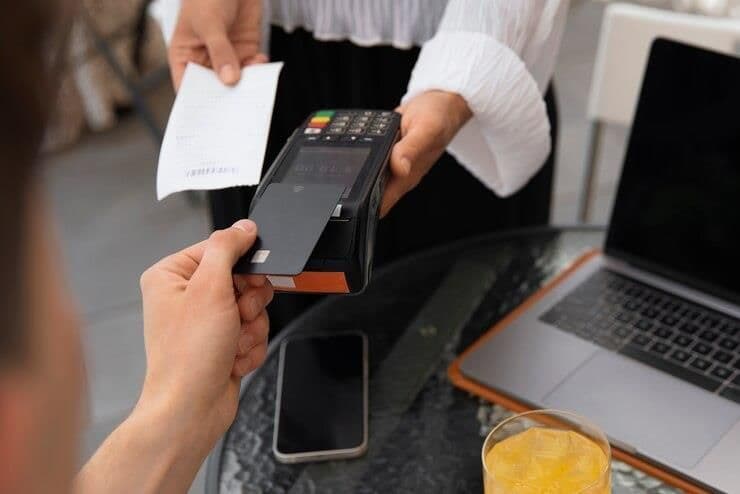
An EFTPOS terminal in Australia is a card payment device that accepts tap, chip, and swipe transactions via the global EFTPOS network and the domestic eftpos system. Transaction fees typically range from 1.4% to 1.6%, with terminals costing $99–$349 to buy or $19–$29 per month to rent. No-lock-in plans are widely available for small businesses.
According to the Australian Payments Network (AusPayNet), card payments now account for the vast majority of consumer transactions in Australia, with contactless payments representing over 95% of all in-person card transactions. That means having a reliable, cost-effective EFTPOS terminal is no longer optional for small businesses — it is essential infrastructure.
APS works with businesses across hospitality, retail, health, and professional services throughout Australia, offering transparent pricing and flexible plans designed around how real businesses operate.
What Is an EFTPOS Terminal and How Does It Work in Australia?
An EFTPOS terminal processes card payments at the point of sale by connecting to payment networks electronically and transferring funds from a customer's account to your merchant account. In Australia, the term covers two distinct but related systems worth understanding.
The global term "EFTPOS" (Electronic Funds Transfer at Point of Sale) refers to any card-present payment made at a physical terminal — whether through Visa, Mastercard, or the domestic network.
The domestic "eftpos" network is a separate Australian payment scheme operated by eftpos Payments Australia Ltd. It processes debit card payments through the local CHQ (cheque) and SAV (savings) account rails — the ones you tap when a customer uses their debit card directly from their bank account.
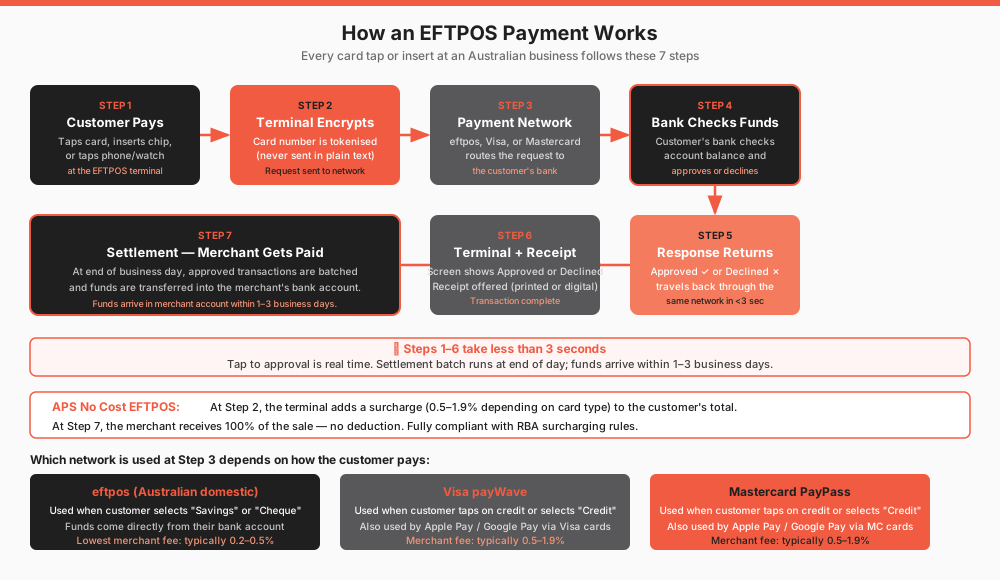
How a Transaction Actually Works
- Customer presents card — tap, chip insert, or swipe
- Terminal reads card data — via NFC (contactless), EMV chip, or magnetic stripe
- Payment request sent — through the payment gateway to the card scheme (eftpos, Visa, or Mastercard)
- Authorisation returned — approved or declined within seconds
- Settlement processed — funds move from the customer's account to your merchant account, typically next business day
Settlement timing matters for cash flow. Most providers settle next business day, though some offer same-day settlement for an additional fee or as a standard feature. For high-volume businesses like cafés and restaurants, this timing directly affects how you manage daily expenses.
Types of EFTPOS Terminals Available in Australia
There are four main terminal types used by Australian businesses, and choosing the right one depends entirely on where and how you trade.
| Terminal Type | Best For | Key Feature |
|---|---|---|
| Countertop | Salons, retail, reception desks | Stable connection, full-size keypad |
| Portable (Bluetooth) | Restaurants, cafés, table service | Cordless within premises range |
| Mobile (4G) | Market stalls, tradies, delivery | SIM-connected, all-day battery |
| Smart POS Touchscreen | Busy retail, hospitality, high volume | Built-in software, large screen |
Countertop Terminals
These plug into your router via ethernet or WiFi and sit at a fixed checkout point. They are the go-to choice for hair salons, pharmacies, and retail boutiques where the customer always comes to the counter. They tend to be more robust and have fewer moving parts to worry about.
Portable Terminals
Portable terminals connect via Bluetooth to a base unit and have a range of roughly 30–50 metres. They are the standard choice for restaurants and cafés where staff need to take payment at the table. Battery life of 6–10 hours covers a full service period.
Mobile (4G) Terminals
These run on a SIM card, making them fully independent of WiFi. A weekend market vendor processing 80+ transactions across a Saturday needs exactly this — a mobile eftpos terminal with all-day battery life and reliable connectivity regardless of location. Tradies, delivery drivers, and pop-up retailers all rely on 4G terminals.
Smart POS Touchscreen Devices
These are Android-based terminals with a large touchscreen, built-in receipt printer, and app ecosystem. Think of them as a tablet and payment terminal in one device. They suit high-volume hospitality and retail businesses that want one integrated device rather than a separate tablet and terminal.
Key Features to Look For in an EFTPOS Terminal
The right terminal is the one that costs you the least, causes the fewest problems, and integrates cleanly with how you already work. Evaluate any provider against these six criteria.
1. Build Quality and Battery Life
A terminal that dies at 2pm on a Saturday is useless. Look for devices rated for 8+ hours of active use, with a ruggedised casing if your environment involves drops, spills, or outdoor use.
2. Transaction Fees
Fees vary significantly. The industry range sits at 1.4%–1.6% per transaction for most card types. Compare flat-rate pricing (one rate for all cards) against interchange-plus models, which pass through the actual card cost. Flat-rate is simpler; interchange-plus can be cheaper at high volumes.
3. Value-Added Extras
Does the terminal support online payments? Can you pull transaction reports? Is there a dashboard to monitor sales across locations? These extras matter when you are running a business, not just taking payments.
4. Contract Terms
This is where many small businesses get caught out. A 24-month or 36-month lock-in contract limits your flexibility if your business changes or a better product launches. Always read the minimum term and cancellation clause before signing.
5. Sign-Up Transparency
Hidden fees — activation fees, PCI compliance fees, statement fees — can add $20–$50 per month on top of what was quoted. A transparent provider lists every fee upfront.
6. Customer Support
When your terminal stops working during a busy Friday dinner service, you need a real person on the phone, not a chatbot. Check whether support is Australian-based and available during trading hours.
APS addresses all six criteria directly, with transparent pricing, no hidden fees, and local support for Australian businesses across retail, hospitality, health, and services.
How EFTPOS Fees Work — and What They Actually Cost Your Business
EFTPOS fees in Australia typically run between 1.4% and 1.6% per transaction, depending on your provider, card type, and monthly volume. Understanding exactly what you are paying — and why — is the difference between an EFTPOS terminal being a cost centre and a manageable business expense.
Transaction Rate Comparison
| Provider Type | Typical Rate | Model |
|---|---|---|
| Square | 1.6% (in-person) | Flat rate |
| Zeller | 1.4% (in-person) | Flat rate |
| Bank terminals | Varies | Interchange-plus or bundled |
| APS | Competitive flat rate | Transparent, no hidden fees |
Rental vs. Purchase
- Purchase outright: $99–$349 depending on terminal type. No ongoing hardware cost.
- Monthly rental: $19–$29/month. Lower upfront cost but adds up over time.
A $29/month rental over 24 months costs $696 — more than double the purchase price of most terminals. For established businesses, buying outright usually makes more financial sense.
Surcharging to Offset Transaction Costs
Under RBA guidelines, Australian merchants are permitted to pass transaction costs on to customers as a surcharge — but the surcharge cannot exceed your actual cost of acceptance. A café charging a 1.5% surcharge on a $6 flat white recovers 9 cents per transaction. Across 200 transactions per day, that is $18 daily or roughly $450 per month returned to your business.
Settlement and Cash Flow
Most providers settle next business day. Some offer same-day settlement. For a Melbourne café owner who switched from a bank-issued terminal on a 24-month contract to a no-lock-in solution, the combination of lower monthly costs and consistent next-day settlement made a measurable difference to weekly cash flow management — without sacrificing reliability.
Surcharging, Settlements and Refunds Explained
Australian businesses can surcharge for card payments, but the amount must reflect your actual cost of acceptance — nothing more. This is enforced by both the Reserve Bank of Australia (rba.gov.au) and the ACCC (accc.gov.au), which actively investigates excessive surcharging complaints.
How Surcharging Works in Practice
- Your provider gives you a Cost of Acceptance figure — e.g. 1.5%
- You may pass this on to customers as a surcharge
- You cannot round up or add a margin — the RBA rule is clear
- The surcharge must be disclosed before the customer pays
Example — retail store: A $100 purchase on a Visa credit card with a 1.5% cost of acceptance means a maximum 1.5% surcharge ($1.50). A shop charging 2% on the same transaction is in breach of RBA guidelines.
Example — café: Many cafés in Melbourne and Sydney now display a flat 1.5% card surcharge on weekdays and a higher surcharge on weekends, where card costs can be higher due to scheme pricing tiers.
Settlement Timing
- Next business day — standard across most providers
- Same business day — available with select providers, sometimes at a premium
- Weekends and public holidays — settlement may be delayed; check your provider's terms
Processing Refunds
Refunds on EFTPOS terminals are straightforward: the transaction is reversed back to the original card. Most providers do not charge a fee for refunds, but your transaction fee on the original sale is typically non-recoverable. Build this into your refund policy if you are in a high-return industry like retail.
EFTPOS Terminals That Integrate With Your POS System
A terminal that integrates with your POS system eliminates manual re-keying, reduces human error, and speeds up the checkout process. This is non-negotiable for any business processing more than 50 transactions per day.
What POS Integration Means in Practice
POS integration means your point-of-sale software sends the transaction total directly to the EFTPOS terminal — the operator does not type the amount in manually. When the customer pays, the result (approved or declined) is automatically recorded back in your POS.
Without integration, staff must:
- Note the total from the POS screen
- Manually enter it on the terminal
- Manually reconcile at end of day
This creates two problems: keying errors during busy service, and time-consuming reconciliation at close.
Common Integration Methods
- Cloud-based API integration — modern terminals connect via software to your POS
- Ethernet/IP integration — direct connection, low latency, suited to high-volume retail
- Bluetooth pairing — used by portable terminals in restaurant environments
Leading payment providers in Australia offer 600+ POS integrations, covering platforms commonly used in hospitality (restaurant management systems), retail (inventory-based POS), and health and beauty (appointment and billing software).
When evaluating a terminal, ask the provider directly: "Does this integrate with [your POS software]?" A good provider will confirm compatibility before you sign up.
Contract Lock-In vs. Flexible Plans — What Australian Businesses Should Demand
Lock-in contracts are a significant financial risk for small businesses — and they are avoidable. Before signing any merchant services agreement, understand exactly what you are committing to.
What Lock-In Contracts Look Like
Banks like Westpac have historically offered EFTPOS terminals on 24-month or 36-month contracts. Breaking the contract early typically incurs:
- Remaining monthly rental fees (sometimes the full balance upfront)
- Early termination fees of $200–$500
- Equipment return costs
For a small business that grows, changes POS systems, or simply finds a better deal, this creates real financial pressure.
No-Lock-In Alternatives
Providers including Square, Zeller, PayNuts, and APS offer month-to-month plans with no minimum term. You are free to cancel at any time without penalty.
What to Check Before Signing
| Clause | What to Look For |
|---|---|
| Minimum term | Ideally no minimum, or 12 months max |
| Early termination fee | Should be zero or clearly capped |
| Price change notice | Provider should give 30+ days notice |
| Equipment ownership | Confirm you own the terminal if purchased |
| Auto-renewal | Watch for contracts that auto-renew for another term |
A no-lock-in eftpos contract is now a reasonable standard expectation for Australian small businesses. If a provider cannot offer month-to-month terms, ask why — and consider whether that flexibility is worth more than any initial incentive they are offering.
APS offers flexible plans designed around Australian business owners, with no lock-in contracts and transparent fee structures.
Why APS Is a Smart Choice for Australian Businesses Needing an EFTPOS Terminal
APS brings together the features that matter most to Australian small businesses: transparent pricing, flexible contracts, strong POS integration, and genuine local support. Whether you run a café in Melbourne, a beauty salon in Brisbane, or a market stall in Perth, the fundamentals are the same — you need a terminal that works, costs what it says it costs, and does not tie you in for two years.
What Sets APS Apart
- No lock-in contracts — cancel any time without penalty
- Transparent fee structure — no hidden activation, compliance, or statement fees
- Multiple terminal types — countertop, portable, and mobile options to match your business
- POS integration — compatible with the major platforms used across hospitality, retail, health, and services
- RBA-compliant surcharging — built-in support for passing on your exact cost of acceptance
- Australian-based support — real people available when your trading day demands it
APS serves businesses across industries where payment reliability directly impacts revenue — hospitality, retail, health, and professional services. The approach is straightforward: give business owners a payment solution that works without the complexity, lock-in, and hidden costs that have historically made merchant services frustrating.
For businesses evaluating eftpos terminals in Australia, the decision comes down to cost, flexibility, and fit. APS delivers on all three.
Ready to Get Started with the Right EFTPOS Terminal?
Choosing the right eftpos terminal in Australia does not have to be complicated. The key is finding a provider that is upfront about fees, does not lock you in, and gives you the right hardware for how your business actually operates.
APS offers merchant payment solutions built for Australian businesses — with no hidden fees, no lock-in contracts, and support from people who understand the local market. Whether you are setting up your first terminal or switching from a bank contract that no longer serves you, the process is straightforward.
Visit [https://aps.business](https://aps.business) today to explore your options and get your business accepting card payments with confidence.