An EFTPOS terminal in Australia is a card payment device that accepts tap, chip, and swipe transactions via the global EFTPOS network and the domestic eftpos system. Transaction fees typically range from 1.4% to 1.6%, with terminals costing $99–$349 to buy or $19–$29 per month to rent. No-lock-in plans are widely available for small businesses.
According to Australian Payments Network (AusPayNet), card payments now account for the overwhelming majority of point-of-sale transactions in Australia, with contactless payments continuing to grow year-on-year. For any small business owner, choosing the right EFTPOS terminal is one of the most consequential operational decisions you will make in 2026. Get it wrong and you are locked into a contract with fees that eat into every sale. Get it right and you have a fast, reliable payment setup that fits your business and your budget.
APS has spent years helping Australian businesses across hospitality, retail, health, and professional services navigate exactly this decision. This guide covers everything you need to know about eftpos terminals in Australia — from how the technology works to what questions to ask before you sign anything.
What Is an EFTPOS Terminal and How Does It Work in Australia?
An EFTPOS terminal is a card payment device that connects to the payments network to transfer funds from a customer's account to a merchant's account in real time. In Australia, there is an important distinction between two systems that share nearly the same name.
EFTPOS (capitalised) is the global term — Electronic Funds Transfer at Point of Sale — that describes the category of technology used for card payments at the point of sale worldwide.
eftpos (lowercase) refers specifically to the domestic Australian payments network operated by eftpos Payments Australia Ltd. This is the local scheme that processes debit card transactions when you see the eftpos logo on an Australian bank card. It runs separately from Visa and Mastercard, and typically carries lower transaction costs for merchants.
How a Payment Is Processed
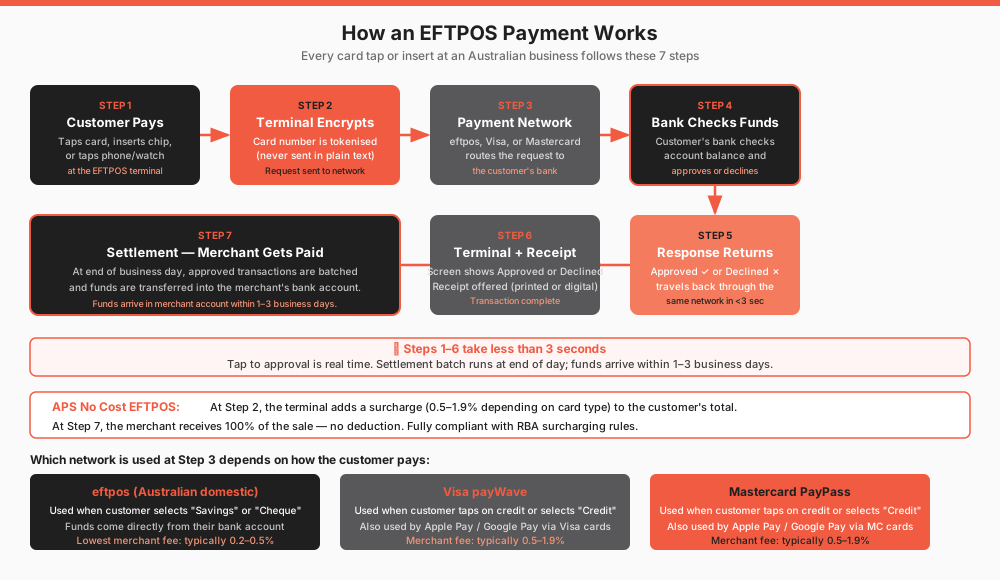
When a customer taps, inserts, or swipes their card at an EFTPOS terminal, here is what happens:
- Card data is read by the terminal (chip, magnetic stripe, or NFC for contactless)
- An authorisation request is sent to the card scheme network (eftpos, Visa, or Mastercard)
- The issuing bank approves or declines the transaction within seconds
- Funds are reserved on the customer's account
- Settlement occurs — typically same-day or next business day — when funds transfer to the merchant's nominated bank account
For Australian merchants, understanding which network a transaction routes through matters because eftpos transactions often attract lower interchange fees than Visa or Mastercard debit, which directly affects your per-transaction cost.
Types of EFTPOS Terminals Available in Australia
There are four main terminal types used by Australian businesses, and the right choice depends entirely on how and where you trade.
1. Countertop Terminals
Countertop terminals are fixed devices that sit at a checkout counter and connect via Ethernet or Wi-Fi. They are the most common terminal type in Australia.
Best for: Hair salons, pharmacies, boutique retail stores, medical practices, and any business with a fixed point of sale.
Why: They offer consistent connectivity and are generally the most cost-effective option for businesses where customers always come to the counter to pay.
2. Portable Terminals
Portable terminals connect via Wi-Fi and can be carried around a venue. Battery life typically allows a full trading day on a single charge.
Best for: Restaurants, cafés, and hotels where staff need to take payment at the table.
Why: Table-side payment is faster, reduces walk-off risk, and creates a better customer experience than asking guests to come to a counter.
3. Mobile (4G) Terminals
Mobile terminals use a built-in SIM card to connect via cellular networks. They operate wherever there is mobile coverage — no Wi-Fi required.
Best for: Market stall traders, food trucks, tradies, pop-up retailers, and delivery businesses.
Why: A weekend market vendor processing 80+ transactions on a Saturday cannot rely on a venue's Wi-Fi. A mobile terminal with a full-day battery and 4G connectivity is the only reliable option. The terminal keeps working whether the trader is at the Gasworks Artisan Market in Brisbane or a school fete in suburban Melbourne.
4. Smart POS Touchscreen Devices
Smart POS devices are Android-based touchscreen terminals that run apps, display menus, and integrate directly with POS software. Think Verifone V240m or PAX A920-style devices.
Best for: Cafés, quick-service restaurants, and retailers who want a fully integrated terminal-and-software solution.
Why: They consolidate your terminal and POS into one device, reducing hardware clutter and enabling richer reporting.
Key Features to Look For in an EFTPOS Terminal
Choosing a card payment terminal in Australia comes down to six core criteria. Here is what to evaluate before committing to any provider.
1. Build Quality and Battery Life
A terminal that fails mid-service is a serious problem. Look for IP-rated durability in environments where liquid spills are common (hospitality), and confirm the quoted battery life is tested under real transaction loads, not laboratory conditions.
2. Transaction Fees
Transaction rates vary between providers. The 1.4%–1.6% range is typical across the market in 2026. Even a 0.2% difference adds up quickly on high volume — a business processing $500,000 annually pays $1,000 more per year at 1.6% vs 1.4%. Always compare the all-in rate, not just the headline rate.
3. Value-Added Extras
The best terminals do more than process payments. Look for:
- Real-time reporting dashboards accessible from a phone or browser
- Online payment links for remote invoicing
- Multi-user access for staff management
- Integration with accounting software like Xero or MYOB
4. Contract Terms
This is where many business owners get caught out. Always ask: What is the minimum term? What are the exit fees? A provider that will not answer these questions clearly is a provider worth avoiding.
5. Sign-Up Transparency
Avoid any provider that charges undisclosed setup fees or buries cost structures in a 40-page agreement. Transparent pricing — where you can see your rate, your rental cost, and your settlement timing on a single page — is a mark of a trustworthy merchant payment solutions provider.
6. Customer Support
When payment fails, you cannot wait 48 hours for an email response. Check whether the provider offers phone support during trading hours, ideally with Australian-based agents who understand local compliance requirements.
APS addresses each of these criteria directly — offering transparent pricing, no hidden fees, and support built around the realities of running an Australian business.
How EFTPOS Fees Work — and What They Actually Cost Your Business
EFTPOS fees in Australia are made up of several components, and understanding each one is essential before you sign up with any provider.
Transaction Rates
The transaction rate is a percentage of each sale charged by your payment provider. In 2026, the typical market range is 1.4%–1.6% across providers including Square, Zeller, PayNuts, and others. Some providers advertise lower rates but apply surcharges on specific card types (Amex, international cards) that push your effective rate higher.
Always ask for your blended effective rate across all card types processed.
Terminal Costs: Rent vs. Buy
| Option | Typical Cost | Best For |
|---|---|---|
| Purchase | $99–$349 upfront | Established businesses planning long-term use |
| Monthly Rental | $19–$29/month | New businesses or those wanting flexibility |
| Bundled Plans | Varies | High-volume businesses negotiating custom rates |
Purchasing outright makes financial sense if you plan to use the terminal for more than 18 months. At $29/month rental, you spend $348 in a year — often more than the purchase price of the device.
Surcharging
Under RBA guidelines, Australian merchants are permitted to pass the cost of card acceptance to customers as a surcharge. Surcharging must not exceed the merchant's actual cost of acceptance — this is the "cost of acceptance" rule enforced jointly by the Reserve Bank of Australia (rba.gov.au) and the ACCC (accc.gov.au).
A typical compliant surcharge for a café or retailer accepting Visa/Mastercard is 1.0%–1.6%. Charging 3% on a transaction that costs you 1.5% to process is excessive and potentially illegal under current Australian consumer law.
Settlement Timing
Most providers offer next-business-day settlement. Some offer same-day settlement for an additional fee or as a standard feature. For hospitality businesses with tight daily cash flow — covering food orders, staff wages, and supplier payments — same-day settlement is worth prioritising.
Surcharging, Settlements and Refunds Explained
Surcharging, settlement, and refunds are the three areas where Australian merchants most often face confusion. Here is a plain-English breakdown.
Surcharging Under RBA Rules
The RBA's "cost of acceptance" standard means your surcharge must reflect what the payment actually costs you — no more. The ACCC actively investigates excessive surcharging complaints.
Practical example: A Melbourne café processes $8,000 per week in card transactions. Their blended transaction rate is 1.5%. They apply a 1.5% surcharge. The surcharge fully offsets the merchant fee, and the business retains its full margin. This is compliant.
What is not compliant: Charging a flat 2.5% surcharge when your provider charges you 1.4%. The difference — 1.1% — is profit on the surcharge, which violates RBA guidelines.
Settlement Timing in Practice
For retail stores, next-day settlement is usually sufficient — weekly wages and supplier invoices are rarely due overnight.
For hospitality businesses, same-day settlement is often critical. A busy restaurant turning over $15,000 on a Friday night may need those funds available Saturday morning to pay casual staff or purchase weekend stock.
Processing Refunds
Refunds on an EFTPOS terminal reverse the original transaction back to the customer's card. Key points for merchants:
- Refunds typically take 2–5 business days to appear on the customer's statement
- The original transaction fee is not automatically refunded by most providers (check your agreement)
- Always issue refunds through the terminal — never as cash in lieu of a card refund, unless agreed with the customer
EFTPOS Terminals That Integrate With Your POS System
POS integration means your EFTPOS terminal communicates directly with your point-of-sale software — the transaction total passes automatically to the terminal without manual entry. This eliminates a significant source of human error at checkout.
Why it matters: Manual entry errors — entering $48.50 instead of $84.50 — cost businesses money and cause customer disputes. Integration removes that risk entirely.
Common Integration Methods
- Direct API integration: The terminal and POS software communicate via a direct software connection — the fastest and most reliable method
- Cloud-based integration: Both the terminal and POS connect to a shared cloud platform to sync transaction data
- Semi-integrated: A middleware layer connects the two systems — common with legacy POS software
Leading payment providers in Australia offer integrations with 600+ POS platforms, covering major hospitality and retail software including Lightspeed, Deputy, Kounta, and others. Before choosing a terminal, confirm your existing POS is on the supported integration list.
For a restaurant running a busy Saturday service, having the POS and terminal fully integrated means a server sends the bill from the handheld POS and the terminal displays the exact amount instantly — no manual input, no errors, no disputes.
Contract Lock-In vs. Flexible Plans — What Australian Businesses Should Demand
Lock-in contracts have been standard in the Australian merchant payments industry for decades — largely through the major banks. In 2026, there is no reason to accept one.
What Lock-In Looks Like
Traditional bank-issued EFTPOS terminals — including those from Westpac, ANZ, and Commonwealth Bank — have historically come with 24-month minimum terms and early exit fees ranging from a few hundred dollars to the cost of remaining monthly rental fees. A business locked into a 24-month rental at $29/month that needs to exit at month 6 faces $522 in exit fees.
The No-Lock-In Alternative
Providers including Square, Zeller, PayNuts, and APS offer month-to-month or no-contract plans. You pay for what you use, and you can exit without penalty.
| Feature | Bank-Issued Terminal | No-Lock-In Provider (e.g. APS) |
|---|---|---|
| Minimum term | 12–24 months | None / month-to-month |
| Exit fees | $200–$600+ | None |
| Rate transparency | Often bundled/opaque | Clear per-transaction rates |
| Setup fees | Often yes | Often none |
| Support | Bank hours only | Extended / dedicated |
What to Check Before Signing
- Ask for the minimum term in writing — verbal assurances are not enforceable
- Request the full fee schedule including setup, rental, transaction, and exit fees
- Check the notice period required to cancel
- Confirm settlement timing is stated in the agreement, not just in marketing material
A Melbourne café owner who switched from a major bank's 24-month terminal contract to a no-lock-in solution through APS eliminated her monthly rental fee and gained the flexibility to reassess her payment setup each year as her business grew. With surcharging enabled, her card acceptance costs effectively became zero.
Why APS Is a Smart Choice for Australian Businesses Needing an EFTPOS Terminal
For Australian businesses evaluating eftpos terminals in 2026, the decision comes down to price transparency, contract flexibility, and genuine fit with how you trade.
APS brings together the features that matter most to small and medium businesses across Australia:
- No lock-in contracts — trade with confidence, not obligation
- Transparent transaction pricing in the competitive 1.4%–1.6% market range
- Support for surcharging in compliance with RBA guidelines, giving businesses the option to offset card acceptance costs
- Terminals suited to every business type — countertop, portable, mobile 4G, and smart POS devices
- Industry-wide coverage — serving hospitality, retail, health, salons, tradies, and professional services businesses across Australia
- POS integration with a wide range of point-of-sale platforms, reducing manual entry and checkout errors
Whether you run a café in Brunswick, a beauty salon on the Gold Coast, a trade business in Perth, or a weekend market stall anywhere in Australia, APS offers a merchant payment solution designed around the realities of your business — not a bank's product calendar.
The combination of flexible terms, competitive fees, and real support from people who understand Australian payments regulation makes APS a standout option among the available card payment terminal providers in Australia.
Get Started With APS Today
Choosing the right EFTPOS terminal for your Australian business should not be complicated. The right solution is transparent on price, flexible on terms, and built to handle the way your business actually operates — whether that is table-side payments in a restaurant, contactless tap-and-go in a retail store, or mobile transactions at a weekend market.
APS delivers exactly that — a no-lock-in, competitively priced merchant payment solution designed for Australian businesses across every industry.
Visit aps.business today to compare terminals, check your rates, and get set up with a card payment solution that works for your business — not against it.