
EFTPOS Australia Explained: What It Is, How It Works, and What It Stands For
Last updated: May 2026
In this guide: What EFTPOS stands for | How EFTPOS started in Australia | How a transaction works | Types of EFTPOS payments | EFTPOS vs POS | Benefits for businesses | EFTPOS fees | Surcharging rules | Card types accepted | Choosing the right terminal | FAQs
For businesses ready to accept card payments, APS offers a complete range of EFTPOS solutions for Australian businesses.
What is EFTPOS Australia and why electronic payments are no longer a convenience in Australia they are an expectation, with businesses increasingly relying on providers such as Advanced Payment Solutions. From suburban cafés and retail stores to mobile tardies and service providers, customers increasingly prefer fast, secure, and cashless payment options. At the center of this shift is EFTPOS, a payment system that has become deeply embedded in how Australian businesses operate.
As Australia moves further into a digital and cash-light economy, understanding what EFTPOS is, how it works, and why it matters in 2026 is essential for business owners. This guide provides a complete, beginner-friendly explanation of EFTPOS in Australia and why it continues to play a critical role in modern commerce.
What Does EFTPOS Mean in Australia?
Definition and Full Form of EFTPOS
EFTPOS stands for Electronic Funds Transfer at Point of Sale. In simple terms, it is a payment system that allows customers to pay for goods or services by transferring money electronically from their bank account to a business at the time of purchase.
When a customer taps, inserts, or swipes their debit card at a payment terminal, the EFTPOS system securely communicates with the customer’s bank to verify available funds and approve the transaction. Once approved, the funds are transferred to the merchant account, usually within a short settlement period.
In Australia, EFTPOS is considered a core payment method because it is widely supported by banks, trusted by consumers, and used daily across nearly every industry.
Unlike cash transactions, EFTPOS provides a digital record of payments, improving accuracy, transparency, and reconciliation for businesses.
Why EFTPOS Is a Core Payment Method in Australia
EFTPOS has become foundational to Australian commerce for several reasons:
- It is supported by almost all Australian-issued debit cards
- It allows direct payments from bank accounts
- It is widely accepted across small and large businesses
- It offers strong security and fraud prevention measures
For many Australians, EFTPOS is the default way to pay for everyday purchases, making it essential for businesses that want to meet customer expectations.
Difference Between EFTPOS and General Card Payments
While EFTPOS is often grouped with “card payments,” there is an important distinction. EFTPOS transactions typically route through domestic debit networks and draw funds directly from a customer’s bank account. Other card payments, such as credit cards, may involve different processing networks and credit facilities.
From a business perspective, EFTPOS is often valued for its reliability, simplicity, and suitability for everyday transactions.
How EFTPOS Evolved in the Australian Market
Australia was one of the early adopters of EFTPOS technology. Initially introduced to reduce reliance on cash and cheques, EFTPOS terminals were first installed in major retail environments and gradually expanded to smaller businesses.
Early Adoption by Australian Banks
Australian financial institutions played a key role in rolling out EFTPOS infrastructure nationwide. This early support helped build consumer trust and familiarity with card-based payments.
Transition to Chip, PIN, and Contactless
Over time, EFTPOS technology evolved to meet higher security standards and change customer behavior.
Key milestones included:
- Magnetic stripe cards being replaced by chip technology
- PIN verification improving fraud protection
- Contactless “tap and go” payments increasing transaction speed
Each advancement made EFTPOS more secure and convenient for both customers and businesses.
Widespread SMB Adoption
Today, EFTPOS is used extensively by small and medium-sized businesses (SMBs) across Australia. From local retailers to service-based operators, EFTPOS enables businesses to accept payments efficiently without relying on cash handling.
How Does EFTPOS Work?
An EFTPOS transaction follows a structured and secure process that ensures payments are authorized and settled efficiently. The customer initiates the payment using their debit card, which is read by the payment terminal. The transaction request is then securely sent to the customer’s bank for authorization.
EFTPOS Transaction Process Explained Step-by-Step
An EFTPOS transaction follows a structured and secure process:
- Customer initiates payment by tapping, inserting, or swiping their debit card
- Payment terminal reads card details securely
- Customer verifies the transaction, usually by entering a PIN or using contactless authentication
- Transaction request is sent to the customer’s bank for authorization
- Bank verifies available funds and approves or declines the transaction
- Funds are transferred to the merchant’s account during settlement
- This entire process typically takes only a few seconds, ensuring minimal disruption at checkout.
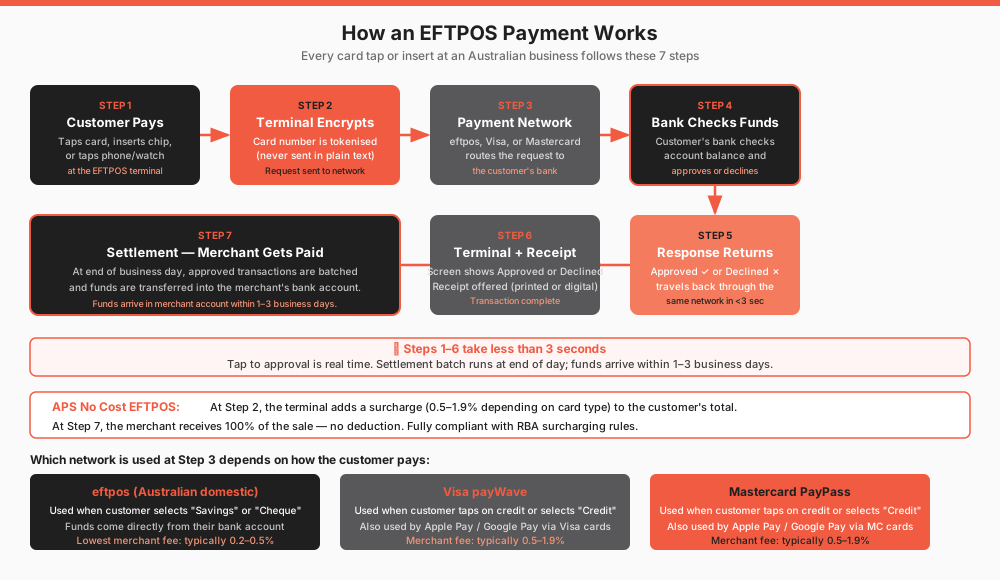
Settlement Into Merchant Accounts
Once a transaction is approved, funds are not always deposited instantly. Instead, they are settled into the merchant account according to the provider’s settlement schedule. This structured process improves accuracy and reduces the risks associated with handling cash.
Types of EFTPOS Payments Used in Australia
Australian businesses commonly use multiple EFTPOS payment methods to meet customer preferences. Traditional chip-and-PIN EFTPOS remains popular for transactions that require added security, while contactless EFTPOS has become the preferred option for everyday purchases due to its speed and convenience.
Traditional Chip and PIN EFTPOS
Chip and PIN EFTPOS remain widely used, particularly for higher-value transactions or situations where additional security is required. Customers insert their card into the terminal and enter a personal identification number to authorize the payment.
Key benefits include:
- Strong authentication
- Reduced risk of unauthorized use
- High acceptance across all customer age groups
This method is especially common in retail environments where security and reliability are priorities.
Contactless EFTPOS Payments
Contactless EFTPOS allows customers to complete transactions by tapping their card or device on a terminal. This method has become increasingly popular due to its speed and convenience.
Advantages of contactless EFTPOS include:
- Faster checkout experiences
- Reduced physical contact
- Improved customer flow during busy periods
By 2026, contactless payments are expected to dominate everyday transactions in Australia, making EFTPOS terminals with contactless capability essential for businesses.
EFTPOS vs POS: Understanding the Difference
EFTPOS and POS systems serve different purposes but often work together. An EFTPOS terminal is responsible solely for processing payments, including APS EFTPOS solutions, securely transferring funds from the customer to the business.
What an EFTPOS Terminal Does
An EFTPOS terminal’s primary function is payment acceptance. It processes debit and card transactions securely and communicates with banking systems to complete payments.
EFTPOS terminals can be:
- Standalone, operating independently
- Integrated, connected to a POS system for automated transaction syncing
What a POS System Does
A POS (Point of Sale) system is broader in scope. It manages:
- Sales records
- Inventory tracking
- Staff activity
- Reporting and analytics
POS systems often integrate with EFTPOS terminals, allowing payment data to flow directly into sales records.
How EFTPOS Integrates with POS Systems
When integrated, EFTPOS and POS systems reduce manual entry, minimize errors, and improve operational efficiency. However, businesses can still operate EFTPOS independently if their needs are simple.
Benefits of EFTPOS for Australian Businesses
EFTPOS enables faster and more efficient transactions, reducing wait times and improving customer satisfaction. This is particularly valuable in high-volume environments such as cafés, retail stores, and service counters.
Faster Checkout and Better Customer Experience
EFTPOS enables quick and seamless transactions, reducing wait times and improving overall customer satisfaction. Faster payments are particularly valuable in high-volume environments such as cafés, retail stores, and service counters.
Lower Payment Processing Complexity
Compared to managing cash, EFTPOS simplifies daily operations by:
- Reducing counting and reconciliation errors
- Minimizing theft risks
- Providing digital transaction records
For many SMBs, EFTPOS contributes to smoother, more predictable operations.
Improved Cash Flow Management
With electronic records and scheduled settlements, EFTPOS helps businesses better manage cash flow. Clear transaction histories also make bookkeeping and financial reporting more efficient.
Why EFTPOS Is Essential for Australian Businesses in 2026
Australia is steadily moving toward a cashless economy, with consumers increasingly relying on card and contactless payments. By 2026, many customers expect businesses to offer reliable electronic payment options as a standard service.
Australia’s Move Toward a Cashless Economy
Cash usage in Australia has steadily declined as consumers embrace digital payment methods. By 2026, many customers expect businesses to offer reliable card and contactless payment options as standard.
Businesses that do not support EFTPOS risk losing customers who no longer carry cash or prefer electronic payments.
Customer Expectations and Trust
EFTPOS is widely trusted by Australian consumers due to its long history and association with secure banking systems. Customers feel confident using EFTPOS for everyday transactions, which directly impacts purchasing decisions.
Future-Proofing Business Payments
EFTPOS continues to evolve alongside digital wallets, mobile payments, and enhanced security technologies. This adaptability ensures it remains relevant as payment behaviors change.
EFTPOS Security in Australia
Security is one of the most important aspects of the EFTPOS system. Every transaction is protected by multiple layers of security to prevent fraud and unauthorised access.
EMV chip technology — the gold or silver chip on debit and credit cards — encrypts each transaction with a unique code that cannot be reused. This makes EFTPOS transactions significantly more secure than older magnetic stripe methods.
PIN verification adds a second layer of authentication for higher-value transactions. For contactless tap payments, banks and card networks apply their own risk controls, including transaction limits and velocity checks, to detect unusual patterns.
EFTPOS terminals in Australia must comply with PCI DSS (Payment Card Industry Data Security Standard) requirements. Compliant terminals encrypt card data at the point of entry and never store sensitive cardholder information on the device.
Merchants using APS terminals benefit from built-in PCI compliance support, removing the burden of managing this independently.
EFTPOS Fees and Transaction Costs
EFTPOS fees in Australia vary by card type and pricing model. There are two main ways providers charge merchants:
Merchant Service Fee model: You pay a percentage per transaction — typically 0.3%–0.5% for domestic eftpos debit, 0.5%–1.0% for Visa/Mastercard debit, and 1.0%–1.9% for credit cards. This comes out of your revenue.
No-Cost EFTPOS (surcharging) model: The fee is passed to the customer as a surcharge at the point of sale. The merchant pays zero per transaction. APS operates on this model — see our No-Cost EFTPOS page.
EFTPOS Surcharging Rules in Australia
Surcharging is legal and regulated by the Reserve Bank of Australia (RBA). The core rule: a merchant's surcharge must not exceed their actual cost of accepting that payment method. The Australian Competition and Consumer Commission (ACCC) enforces these rules — businesses charging excessive surcharges can be investigated and fined.
Merchants must disclose the surcharge to the customer before the transaction is completed. Modern terminals handle this automatically by showing the surcharge amount on screen before the customer confirms.
Typical compliant surcharge ranges based on RBA cost of acceptance data: eftpos debit 0.3%–0.5%, Visa/Mastercard debit 0.5%–1.0%, Visa/Mastercard credit 1.0%–1.9%, American Express up to 2.0%.
EFTPOS Card Types Accepted in Australia
Modern EFTPOS terminals accept all major card types: eftpos domestic debit (lowest merchant cost), Visa Debit, Mastercard Debit, Visa Credit, Mastercard Credit, American Express, and digital wallets including Apple Pay and Google Pay. Digital wallets route through the underlying card network so the same fees apply as the physical card.
Important distinction: eftpos (lowercase) is Australia's own domestic payment network, operated by Australian Payments Plus. It is separate from Visa and Mastercard and typically carries the lowest transaction cost for merchants. Most modern Australian debit cards are dual-network — they carry both the eftpos logo and either Visa or Mastercard.
How to Choose the Right EFTPOS Terminal
The right terminal depends on how your business operates:
Countertop terminals — best for fixed checkout points like retail counters and reception desks. Reliable and ideal for high transaction volumes.
Portable (wireless) terminals — ideal for table-service restaurants and businesses where payment moves around. Connect via WiFi or Bluetooth.
Mobile terminals — for businesses on the go: markets, food trucks, mobile tradies. Connect via 4G/LTE.
Integrated terminals — connect directly to your POS system so sale totals are sent to the terminal automatically, eliminating manual entry errors.
APS offers all terminal types with no-cost EFTPOS available across the range. Learn about No-Cost EFTPOS | Get a free quote.
Explore the full range of EFTPOS machines available from APS, from countertop to portable options.
When evaluating EFTPOS providers, ask about settlement timeframes, minimum transaction volumes, cancellation fees, lock-in periods, and what support is available if the terminal goes offline during trading hours. These details significantly affect your day-to-day operations and total cost.
APS Payment Solutions provides next-business-day settlement, no lock-in contracts, and local Australian support. The no-cost EFTPOS model means your business keeps 100% of each sale, with the surcharge transparently displayed to customers at the terminal before they tap or insert their card.
For businesses processing high volumes — retail, hospitality, healthcare, or trades — even a 1% merchant service fee on $500,000 annual card turnover equals $5,000 per year in fees. Understanding your payment costs is not just an administrative task; it is a meaningful business decision.
Australia's shift toward a cashless economy is well documented. The Reserve Bank of Australia's Consumer Payments Survey shows cash now accounts for less than 20% of all transactions, down from over 60% a decade ago. For businesses, this means that having a reliable, fast, and cost-effective EFTPOS setup is no longer optional — it is a baseline requirement for serving the modern Australian customer.
EFTPOS and the Future of Payments in Australia
Australia is one of the most advanced card payment markets in the world, and EFTPOS continues to evolve alongside new payment technologies. The rise of digital wallets, buy-now-pay-later services, and open banking has not replaced EFTPOS — it has expanded the ecosystem around it.
Contactless payments now account for the majority of in-person transactions in Australia. The eftpos network has responded by launching eftpos QR and expanding its digital wallet capabilities, ensuring the domestic network remains competitive alongside Visa and Mastercard.
For Australian businesses, the most important shift is the move toward integrated payment ecosystems. Modern EFTPOS terminals connect directly to POS software, accounting platforms like Xero and MYOB, and inventory systems — removing manual data entry and reducing reconciliation time significantly.
The surcharging model has also gained significant traction. With rising merchant service fees across all networks, no-cost EFTPOS gives small businesses a practical way to accept all card types without eroding margins. Regulatory clarity from the RBA has made surcharging more transparent and easier to implement compliantly.
Businesses that understand how EFTPOS works, what fees apply to each card type, and how to configure their terminal setup are better positioned to manage costs, serve customers efficiently, and grow without being locked into expensive payment contracts.
Conclusion
EFTPOS remains a cornerstone of Australian business payments. It provides a secure, efficient, and widely trusted way to accept customer payments while supporting the nation’s transition toward a cash-light economy.
As customer expectations continue to evolve in 2026, businesses that rely on EFTPOS are better positioned to deliver fast transactions, maintain operational control, and build customer trust. Understanding how EFTPOS works and choosing the right setup is no longer optional it is a fundamental part of running a modern Australian business.
Get in touch With APS for expert support.


